

Aliyu Idris, PhD
There is a particular kind of institutional turnaround that defies easy explanation, the kind that happens not gradually, not incrementally, and not through the slow accumulation of marginal improvements, but through a sudden, decisive, and comprehensively executed intervention that changes the fundamental conditions of a system so thoroughly that its outputs are transformed beyond recognition within a remarkably short period. Kano State’s education sector has undergone precisely that kind of turnaround under Governor Abba Kabir Yusuf, and the 2025 NECO results, which placed Kano first among all states in Nigeria, are its most visible, most measurable, and most nationally resonant expression.
To appreciate the full significance of that achievement, one must first understand the depth of the crisis from which it emerged. When Governor Yusuf assumed office in May 2023, Kano’s public education system was a landscape of accumulated neglect whose dimensions were visible to anyone willing to look honestly at the evidence. Hundreds of school buildings across the state’s 44 local government areas were in various states of disrepair, with classrooms lacking roofs, walls crumbling, toilets non-functional, and basic furniture absent. Thousands of children of school age were not in school, deterred by a combination of poor infrastructure, financial barriers, inadequate teaching quality, and the simple absence of the conditions that make learning possible. Teacher shortages were chronic and severe, with mathematics and science subjects particularly undersupplied, a deficit whose consequences for student performance in national examinations were measurable and consistently damaging. The financial barriers associated with public examinations, specifically the cost of registering for NECO, NABTEB, AIED, and JAMB, were excluding thousands of otherwise capable students from the credentialing pathways that access to higher education and formal employment requires.
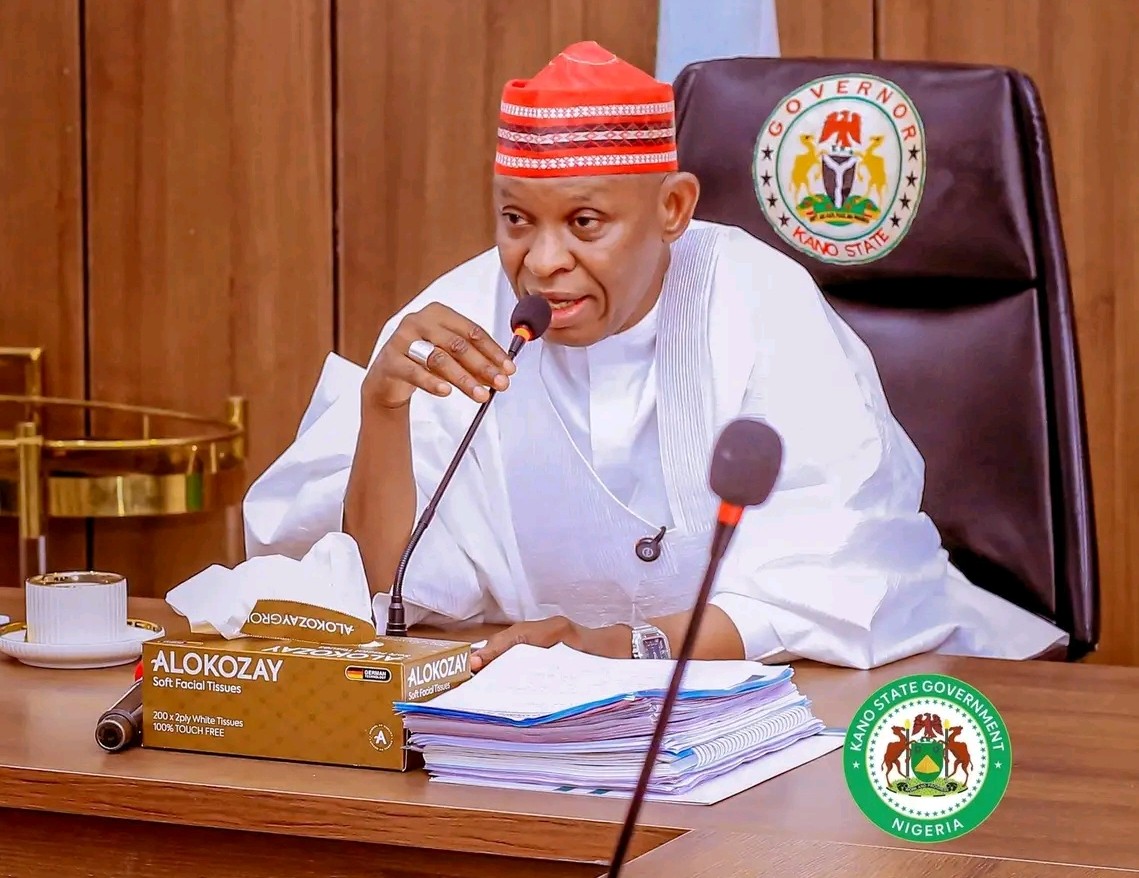
Governor Yusuf did not respond to this crisis with the cautious, piecemeal interventionism that Nigerian educational reform has too often been characterised by. He responded with a declaration of a state of emergency in education, a declaration that was not merely rhetorical but was immediately backed by the most consequential financial commitment in Kano’s education history: an allocation of 30 percent of the state’s annual budget to the education sector, the highest share of any state government’s budget dedicated to education anywhere in Nigeria. That single decision, taken in the earliest months of the administration, signalled with unmistakable clarity that this was a government that intended to treat education not as a line item in a budget document but as the foundational investment upon which every other development objective depended.
The implementation of that commitment was as broad as it was deep. Across all 44 local government areas of the state, classrooms were renovated, roofs were repaired, walls were rebuilt, furniture was replaced, and the physical environment of learning was restored to the standard that children deserve and that effective teaching requires. The provision of 50,000 crate bags to primary and secondary school students addressed the material needs of students whose poverty was a barrier to full participation in their own education. The payment of NECO, NABTEB, and AIED examination registration fees for students across the state removed the financial barrier that had been preventing thousands of capable young people from sitting for the national examinations that determine their futures, with the Kano State Executive Council approving N3.17 billion for this purpose in a single session, followed by a further N4.45 billion for examination fees in 2026 alone. The recruitment of 400 Mathematics teachers directly targeted the subject-specific staffing deficit that was most directly responsible for poor student performance in the quantitative disciplines that NECO and other national examinations assess most heavily.
The Abba Care Scheme’s extension of health insurance coverage, while primarily a healthcare intervention, contributed indirectly to educational outcomes by reducing the household financial shocks that too often pulled children out of school in the middle of examination cycles. The establishment of Kano State Polytechnic in Gaya expanded the technical and vocational education options available to students in the state’s southern corridor, ensuring that the pathway from basic education to skilled employment or higher learning was available to communities that had previously lacked institutional access to it. The expansion of scholarship programmes provided an additional incentive structure that aligned student aspirations with academic performance, reinforcing the culture of educational seriousness that the administration’s broader investment was designed to build.
The result of all of this was not merely statistical improvement. It was a fundamental transformation in the relationship between the Kano State education system and its students, a transformation that expressed itself in the 2025 NECO results with a clarity and a definitiveness that left no room for ambiguity. For the first time in its history, Kano State ranked first among all states in Nigeria in the national senior secondary school examinations, a result that attracted national attention, generated widespread media coverage, and was celebrated by educators, parents, students, and governance observers across the country as evidence that the most intractable educational challenges can be overcome when the right leadership makes the right investment with the right level of commitment.
The significance of this achievement extends well beyond its immediate educational implications. It is a statement about what governance can accomplish in three years when it is guided by evidence, backed by resources, and executed with the discipline and the consistency that transformational public investment requires. It is a statement that directly challenges the cynicism that too often surrounds discussions of Nigerian education reform, the pessimistic assumption that the system is too broken, too large, and too deeply entrenched in its dysfunction to be substantially improved within a single electoral term. Kano’s 2025 NECO performance is a comprehensive empirical refutation of that assumption.
It is also, as Kano marks its third anniversary under Governor Yusuf, a statement about the nature of the administration’s governing philosophy at its most fundamental level. An administration that dedicates 30 percent of its budget to education, that pays the examination fees of hundreds of thousands of students, that recruits hundreds of teachers to fill the specific gaps that are most directly limiting student performance, and that delivers a first-place national examination result within three years of assuming office, is an administration that understands something critically important: that the most consequential investment any government can make is not in roads or buildings or institutional infrastructure, important as all of those are, but in the human beings who will use those roads, occupy those buildings, and staff those institutions for the next half-century.
Kano’s children, who sat for NECO in 2025 and saw their state top the national rankings, did not achieve that result because they suddenly became more intelligent or more hardworking than their counterparts in other states. They achieved it because, for the first time in many of their educational lives, they had a government that gave them classrooms worth learning in, teachers worth learning from, examination fees paid on their behalf, and the simple, profound signal that their education mattered enough to be treated as the state’s highest priority. That signal is worth more than any trophy, any award, or any anniversary celebration. It is the most important thing a government can communicate to its children. And Governor Abba Kabir Yusuf communicated it, with full conviction and full investment, from the very first months of his administration.
Three years later, the children of Kano are answering back. And their answer is first place.